
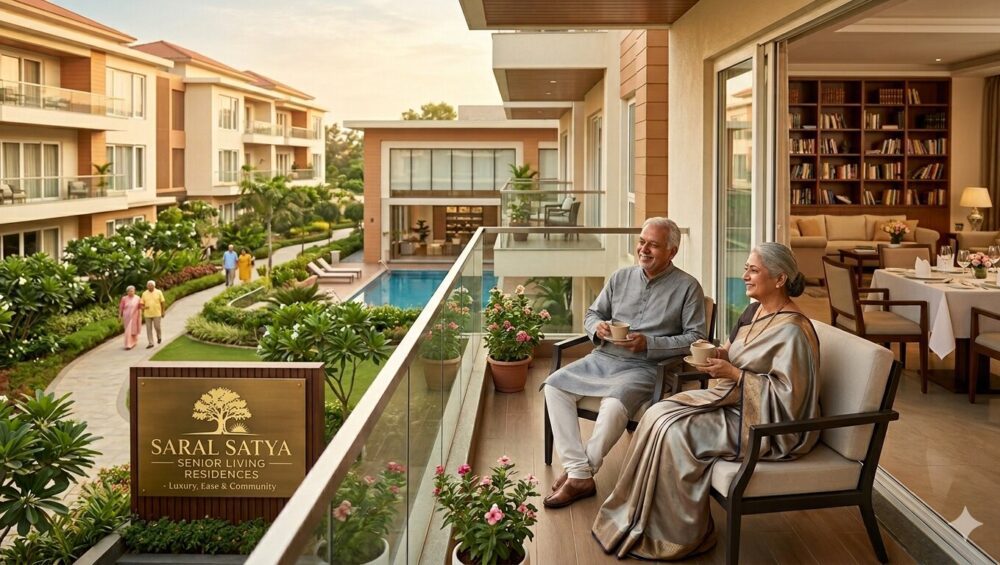
There comes a stage in life when comfort is no longer about abundance. It is about calibration.
A large family home, once a marker of achievement, can begin to feel oddly inefficient in old age. Too many rooms. Too many stairs. Too much dependence on drivers, domestic staff, maintenance schedules, repair work, and medical appointments arranged around an ageing body. Nothing is dramatically wrong. It is simply that the machinery of daily life begins to take up more attention than it should.
This is the space in which luxury retirement homes in India have found their relevance. Not as an emotional fallback, and certainly not as an institutional solution, but as a more considered way of living. They are meant for older adults who do not want their world to shrink simply because they no longer wish to manage every moving part of it themselves.
The appeal is easy to understand. A well-run luxury retirement community offers privacy without isolation, service without fuss, and support without the atmosphere of dependency. It replaces domestic complexity with order. It protects standards. It preserves the texture of a well-lived life.
What luxury means in senior living
Luxury, in this context, has less to do with display than with ease.
It is visible, of course, in the outward form of the place: generous rooms, quiet corridors, landscaped grounds, well-kept common areas, a dining room that feels more residential than institutional. But those are only the surface signs. The deeper luxury lies in what the resident no longer has to think about.
Meals are prepared properly. Housekeeping is regular. Security is competent and discreet. Transport is arranged. Medical support is close enough to reassure, but not so dominant that the place feels clinical. Someone notices when a medicine needs to be managed, when a check-up must be scheduled, when a resident needs assistance, when they need to be left alone.
That combination is rare. It is also what separates premium retirement homes from ordinary senior accommodation. The difference is not only in how the property looks. It is in how the day moves.
The amenities that matter
The best luxury retirement homes understand that amenities are not props. They shape mood, routine, and self-respect.
A resident may have a private apartment or villa with enough space for books, photographs, familiar furniture, and the small visual language of a personal life. There may be walking paths shaded by trees, a lounge where people sit after breakfast, a library corner that is actually used, a fitness room that feels calm rather than performative, a dining hall that does not resemble a cafeteria. Nothing needs to announce itself too loudly. The setting should feel polished, not staged.
Then there are the services that make the place genuinely livable: housekeeping, laundry, maintenance, chef-managed dining, on-call support, transport, emergency response systems, medication assistance, routine health monitoring, physiotherapy, visiting doctors, and coordination with nearby hospitals.
In a younger household, people absorb these responsibilities into the background of life. In old age, each one acquires weight. A premium retirement home works because it removes that weight without drawing attention to the removal.
Lifestyle, not lodging
People often speak of amenities first because they are visible. The real decision, however, is about lifestyle.
A premium retirement home does not merely provide a residence. It changes the tempo of living. The day becomes less cluttered. Less administrative. Less reactive.
Breakfast does not depend on whether the cook has come in. A doctor’s visit does not require a chain of calls. A leaking tap does not become a household event. A missed medicine is less likely to slip unnoticed through the day. Family visits become visits rather than inspections of how well things are being managed.
That shift is more profound than it sounds. It allows older adults to inhabit time differently. They can read in the afternoon without the sense that something practical is being neglected. They can join a conversation, a cultural evening, a walk, a devotional gathering, a class, or choose none of these and remain entirely at peace in their own company. A well-designed environment makes choice possible again.
That is one of the understated benefits of luxury. It returns mental space.
Why affluent families are drawn to premium retirement homes
For many Indian families, the interest in premium retirement homes is not driven by fashion. It comes from a collision between modern urban life and traditional expectations.
Children often live in different cities or countries. Parents may resist moving into a son’s or daughter’s home, not out of distance, but out of temperament. They want their own space, their own routines, their own authority over the shape of the day. At the same time, living alone in a large home can become increasingly impractical. The old arrangement begins to fray at exactly the point when stability matters most.
Luxury retirement homes answer this with a particular kind of proposition. They offer an environment that feels elevated enough to be chosen with pride, but structured enough to reduce vulnerability. For many families, that balance is the entire point. The residence should not feel like a surrender of status. It should feel like a better alignment between age, comfort, and circumstance.
That social dimension is real. People who have spent decades building a certain standard of life do not want their later years to be organised around compromise alone. They want calm, yes. Safety, certainly. But they also want discretion, polish, and an environment that feels commensurate with who they are.
The benefits that endure
The first benefit is practical: less friction. Household management recedes. So does the constant need to coordinate drivers, maintenance staff, domestic help, and medical logistics.
The second is physical: the environment is easier on the body. Good senior living communities are designed for mobility, visibility, safety, and access. They allow people to move through the day with more confidence and less effort.
The third is medical: support is within reach. Not in the invasive sense, but in the reassuring sense. Help exists. Systems exist. Escalation exists. Families do not have to improvise every time something changes.
The fourth is social: companionship becomes ambient rather than forced. One can have privacy without drifting into isolation. There are people nearby, conversations available, shared spaces that do not require performance, and enough social life to keep the emotional climate of the day from turning flat.
The fifth is psychological: a good retirement community reduces low-grade anxiety. It takes away the background hum of “what if something happens?” That matters more than most families realise. Peace of mind is not a decorative benefit. It changes the quality of ordinary life.
The atmosphere of a good luxury retirement home
The atmosphere is often what decides the matter, though families do not always recognise it immediately.
The best places do not feel busy. They feel settled. The staff are attentive without becoming overfamiliar. The residents look neither managed nor abandoned. The common spaces carry a certain ease. The place is clean without smelling aggressively sanitised. Meals are served with civility. The decor is restrained. There is enough beauty to lift the eye, enough quiet to lower the pulse.
One notices these things instinctively. So do parents.
A premium retirement home should feel like a private residential world that has been intelligently adapted to old age. Not a hospital softened by interior design. Not a resort dressed up as elder care. Something more mature than either.
For whom these homes make sense
Luxury retirement homes are best suited to older adults who value independence, order, and privacy, but no longer want the burden of running a full household. They make sense for people who want to remain socially alive without being socially obligated, who appreciate good service, and who expect their environment to reflect a certain standard.
They are also especially relevant for those whose families are spread out, for couples who would rather simplify life while they are still well enough to enjoy it, and for individuals who want ageing to happen in a place designed for it rather than in a home constantly being retrofitted around it.
That last point is often overlooked. The move is not always driven by need. Sometimes it is driven by judgment. By the recognition that life can be arranged more elegantly before difficulty forces the decision.
Choosing well
A polished brochure tells very little.
What matters is the lived character of the place. How the staff speak. Whether the dining room is actually pleasant. Whether the corridors are full of light or merely expensive finishes. Whether healthcare support is integrated or outsourced into a promise. Whether the residents appear at ease in their own skin. Whether the property feels inhabited by real life or prepared for a sales visit.
Families should look for competence, certainly, but also for tone. A senior living community reveals itself in tone. Some places are efficient but cold. Some are warm but chaotic. The best ones combine composure with care. They know how to preserve dignity while making support feel normal.
That is the test.
Conclusion
The rise of luxury retirement homes in India says something larger about how ageing is now being imagined. Old age is no longer being planned only around illness and dependence. It is increasingly being planned around comfort, continuity, and quality of life.
That is why premium retirement homes matter. They offer more than amenities and more than assistance. They offer an environment in which later life can retain grace, privacy, and social confidence. They remove avoidable strain. They support health without turning life into a clinical routine. They allow older adults to live in settings that feel secure, refined, and entirely compatible with the standards they have spent a lifetime cultivating.
For the right resident, that is the real luxury: not opulence, but ease without diminishment.
FAQs
Q1. What are luxury retirement homes?
Ans. Luxury retirement homes are high-end senior living communities designed for older adults who want comfort, privacy, service, safety, and a more refined everyday lifestyle. They usually combine premium residences with hospitality-style services and integrated support.
Q2. How are premium retirement homes different from regular retirement homes?
Ans. Premium retirement homes typically offer better design, more personal space, stronger service standards, a more polished environment, and better access to lifestyle and healthcare support. The difference lies not just in amenities, but in the quality of the overall experience.
Q3. What amenities do luxury retirement homes usually offer?
Ans. They often include private apartments or villas, landscaped outdoor spaces, dining services, housekeeping, laundry, wellness facilities, emergency support, transport assistance, community spaces, and access to medical or rehabilitation services.
Q4. Are luxury retirement homes suitable for active seniors?
Ans. Yes. Many luxury retirement homes are ideal for active, independent seniors who want a well-managed environment, social ease, and freedom from the operational burden of maintaining a large home.
Q5. What are the main benefits of premium retirement homes?
Ans. The main benefits include comfort, safety, reduced household responsibility, healthcare support, social connection, privacy, and peace of mind for both residents and their families.
Q6. Why are luxury retirement homes becoming popular in India?
Ans. They are becoming more relevant because many families want senior living options that combine support with quality of life. As expectations around ageing change, more older adults are choosing environments that feel secure, elegant, and consistent with the way they have lived.