
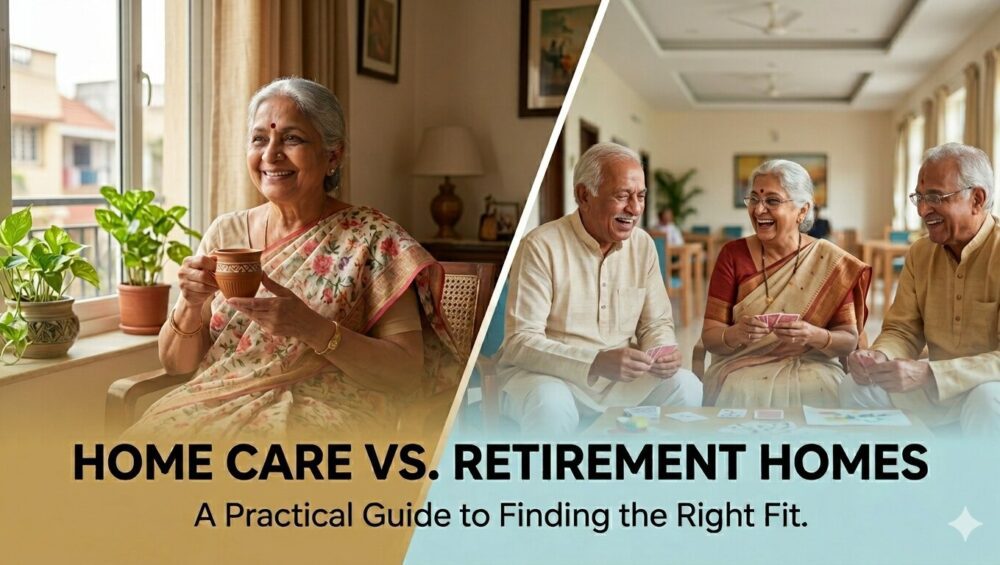
When a family is deciding between senior citizens home care and a retirement home, the decision usually looks emotional on the surface and operational underneath. Everyone talks about comfort, attachment, and what feels right. The harder questions sit below that. Is the house still safe enough? Can your parent manage the long hours between meals and medicines? How much of the arrangement depends on one caregiver turning up and doing their job well? How often is the family quietly stepping in to hold the whole thing together?
That is the only sensible way to compare these two options. Not as symbols. As systems.
The choice becomes clearer when judged against a few practical criteria: safety, medical responsiveness, social life, family workload, privacy, adaptability, and cost over time. Once those are on the table, the comparison usually stops feeling abstract. It becomes a question of fit. The real issue is not which option sounds kinder. It is which arrangement allows a mother or father in later life to live with more steadiness, less strain, and more dignity.
A quick comparison
| Criteria | Home care is usually stronger when… | Retirement homes are usually stronger when… |
| Familiarity | Your parent is deeply attached to the house and routines | The house itself has become tiring, unsafe, or hard to manage |
| Safety | The home is easy to navigate and reliable help is present | Falls, near-falls, night-time needs, or emergency risk are increasing |
| Medical support | Care needs are moderate and the family can coordinate well | Medicines, monitoring, and response need to be more structured |
| Social life | Family visits are frequent and the parent is not isolated | The day has become too quiet and loneliness is setting in |
| Family burden | Someone can supervise the arrangement consistently | The family is stretched by caregivers, appointments, and crisis management |
| Privacy | Personal space and familiar surroundings matter most | Privacy is still important, but support and stability matter more |
| Cost over time | Care needs are light and unlikely to increase soon | Costs at home are becoming layered, unstable, or hard to predict |
That table gives the broad shape of the choice. The real decision sits in the details.
What home care gets right
The appeal of home care is obvious. Your parent stays where life already makes sense.
The room is familiar. The light falls where it always has. The cupboard, the prayer corner, the dining chair, the balcony, the sounds of the neighbourhood — none of that has to be translated into a new setting. For many families, this matters a great deal. A house is not just a structure. It holds memory, authority, and habit. For a mother or father who still feels anchored by that environment, staying home can preserve emotional ease in a way no new place can immediately match.
Home care also gives a family more control over the rhythm of the day. Meals can remain familiar. Visitors do not need to fit into institutional routines. A good caregiver can adapt closely to your parent’s habits rather than the other way around. If the care required is still moderate, and the house is reasonably safe, this can work very well.
That is the strongest case for senior citizens home care: it protects continuity.
Where home care becomes more fragile
The weakness of home care is not that it fails dramatically. It is that it often becomes harder in increments.
A parent needs a little more support with bathing. Then medicines need closer watching. Then the caregiver needs supervision. Then night-time becomes a concern. Then the doctor says someone should keep an eye on eating, walking, or hydration. None of this looks like a crisis by itself. Together, it begins to change the whole arrangement.
This is where the phrase senior citizen stay home can become misleading. A parent may indeed stay home, but the home is no longer doing what it once did. The family starts compensating for the house, for the staffing gaps, for the unpredictability of care. Someone has to check the medicines. Someone has to manage the caregiver’s leave. Someone has to think about what happens if your parent feels dizzy at 11 p.m. or slips in the bathroom when nobody is in the room.
The house remains familiar. The arrangement becomes increasingly fragile.
That is one of the most common pain points families run into. They think they are choosing continuity. What they slowly inherit is coordination.
What retirement homes do better
A retirement home begins from a more practical assumption: later life works better when support is built into the environment instead of layered awkwardly onto it.
That changes the day in important ways. Meals do not depend on domestic reliability. Housekeeping is not an issue to supervise. Help is physically closer. The environment is usually easier to move through. Support at night is not based on hope. Medical needs are more visible within the system. A family does not have to reinvent the arrangement every time the parent’s condition changes slightly.
This is the real strength of retirement homes. They reduce the number of things that can quietly go wrong.
They also reduce the pressure on one person. At home, a great deal may rest on a single caregiver. In a retirement home, the care is usually less personalised in that one-to-one sense, but more stable because it is part of a larger operating system. That trade-off matters. Families often overvalue intimacy and undervalue reliability until reliability becomes the missing thing.
Safety: where the difference becomes hard to ignore
If the comparison is being made primarily on safety, retirement homes often have the advantage.
That is not because every retirement home is excellent. It is because the environment is usually designed with age in mind. Bathrooms, corridors, lighting, staffing, and response systems tend to reflect the fact that older residents may move more slowly, need support at unpredictable times, or require quicker help when something changes.
At home, safety depends on several moving parts behaving well at the same time. The house must be suitable. The caregiver must be present and attentive. The family must remain alert. Medical escalation must be coordinated from outside. When all of that works, home care can be perfectly adequate. But it is more exposed to disruption.
Families usually feel this difference most clearly after a fall, or even after a few near-falls. A parent may still look “fine” overall, but the confidence in the arrangement starts to weaken. Once that happens, the emotional cost of staying home rises quickly.
Loneliness: the factor families often underestimate
Many decisions about elder care are made as though safety is the whole story. It is not.
A mother or father can be medically stable and still be living through long, airless days. The television stays on. Meals are solitary. Calls from family are affectionate but brief. The caregiver may be present, but presence is not the same as company. Over time, the day becomes thin. Nothing is visibly wrong, but the life inside it begins to narrow.
Home care does not automatically solve that.
Retirement homes often do better here, not because they force sociability, but because they create the possibility of ordinary human contact. There are other residents. There are shared spaces. There is a dining room, a corridor, a garden bench, a chance encounter. A parent can still keep to themselves if they wish, but they are less likely to disappear into silence without anyone noticing.
For families whose parent’s biggest problem is not illness but shrinking social life, this part of the comparison matters more than many brochures or care plans will admit.
Family burden: the part nobody wants to phrase bluntly
This decision is often described as though only the parent’s life matters. In reality, the family’s carrying capacity matters too.
Home care can demand a great deal from adult children, especially when they live elsewhere. The work is not always visible, which makes it more tiring. There are phone calls, check-ins, staffing issues, doctor coordination, medicine tracking, emergency planning, and the low, continuous pressure of wondering whether what you are hearing on the phone matches what is actually happening in the house.
Even when the arrangement is loving, it can become consuming.
A retirement home usually reduces that load because more of the daily structure sits within the place itself. The family remains emotionally involved, but less often as the central organiser of everything. That shift can improve life not only for the children, but also for the parent. Visits become less supervisory. Conversations become less functional. The relationship has more room to return to itself.
That is not selfish. It is one of the most legitimate criteria in the comparison.
Cost: what looks cheaper is not always cheaper
Families often assume home care is the economical option and retirement living is the premium one. That is sometimes true at the beginning. It is much less reliable over time.
At home, the visible costs may seem manageable: a caregiver, existing household staff, doctor visits, medicines. But as needs rise, costs thicken around the edges. Night support may be needed. Physiotherapy may become regular. Transport, medical consumables, home modifications, backup staff, and emergency arrangements begin to accumulate. So does the cost of instability when a caregiver leaves unexpectedly.
Retirement homes usually come with a more concentrated monthly fee. That can feel expensive because the number is explicit. But it is also often more predictable. Meals, support, housekeeping, safety, and day-to-day structure are folded into a clearer financial arrangement.
So the right question is not which option appears cheaper when written on a notepad. It is which one remains manageable once your parent is living with the level of help they genuinely need.
When home care is usually the better decision
Home care is usually the better answer when your parent is still fairly stable, strongly attached to the house, and clearly comforted by staying in familiar surroundings. It works best when the home itself is reasonably safe, when the family can supervise without being exhausted by it, and when the care needs are still limited enough that the arrangement does not depend on constant rescue from the outside.
It is also often the better option when privacy matters deeply, and when a move would create more distress than relief.
In such cases, staying home is not denial. It can be a sensible and humane choice.
When a retirement home is usually the better decision
A retirement home becomes the stronger option when the home arrangement is no longer robust enough to be trusted comfortably. That usually happens before families are emotionally ready to say it out loud.
Your parent may not be in dramatic decline, but the day has started requiring too much management. Medicines need closer watching. Mobility is less certain. Bathing or night-time support is becoming harder. One caregiver has become too central to the arrangement. Loneliness is becoming part of the texture of the week. The family is no longer just staying involved; it is quietly compensating for the weaknesses of the whole setup.
In that situation, retirement living is often not the harsher choice. It is the more honest one.
Which is better?
Neither option deserves to win in the abstract. The better arrangement depends on what problem you are actually trying to solve.
If the central need is emotional continuity, privacy, and staying in known surroundings, home care may be the stronger answer.
If the central need is reliability, safety, social texture, and relief from constant coordination, a retirement home may be better.
If the parent is comfortable but the family is collapsing under the logistics, that matters. If the parent is safe but deeply lonely, that matters. If the parent wants to stay home but the home is no longer truly serving them, that matters most of all.
The point is not to choose the option that sounds nobler. It is to choose the one that works.
Conclusion
The comparison between senior citizens home care and retirement homes should be made on lived criteria, not sentiment alone. Safety, medical responsiveness, loneliness, family burden, cost stability, and the quality of the ordinary day matter more than any idealised image of either arrangement.
Home care preserves familiarity and personal rhythm. Retirement homes offer more built-in structure, easier support, and a stronger defence against fragility and isolation. Each can be right. Each can become wrong when chosen for the wrong reasons.
The real question is still the simplest one: which arrangement allows a mother or father in later life to live with more safety, ease, and dignity?
FAQs
Q1. What is the biggest advantage of senior citizens home care?
Ans. Its biggest advantage is familiarity. Your parent remains in known surroundings, with their own routines, belongings, and neighbourhood still intact.
Q2. What is the biggest advantage of a retirement home?
Ans. Its biggest advantage is structure. Support, meals, safety, and daily routines are already built into the environment rather than being coordinated from outside.
Q3. Is home care better for parents who do not want to move?
Ans. Sometimes, yes. But only if the house is still safe enough and the care arrangement is strong enough to remain dependable over time.
Q4. Are retirement homes better for parents who live alone?
Ans. Often they are, especially when loneliness, missed medicines, mobility issues, or caregiver dependence are becoming regular concerns.
Q5. Which option is more affordable in the long run?
Ans. It depends on the level of need. Home care may seem less expensive at first, but costs often become layered and unpredictable. Retirement homes may appear costlier upfront, but are often easier to budget month to month.