
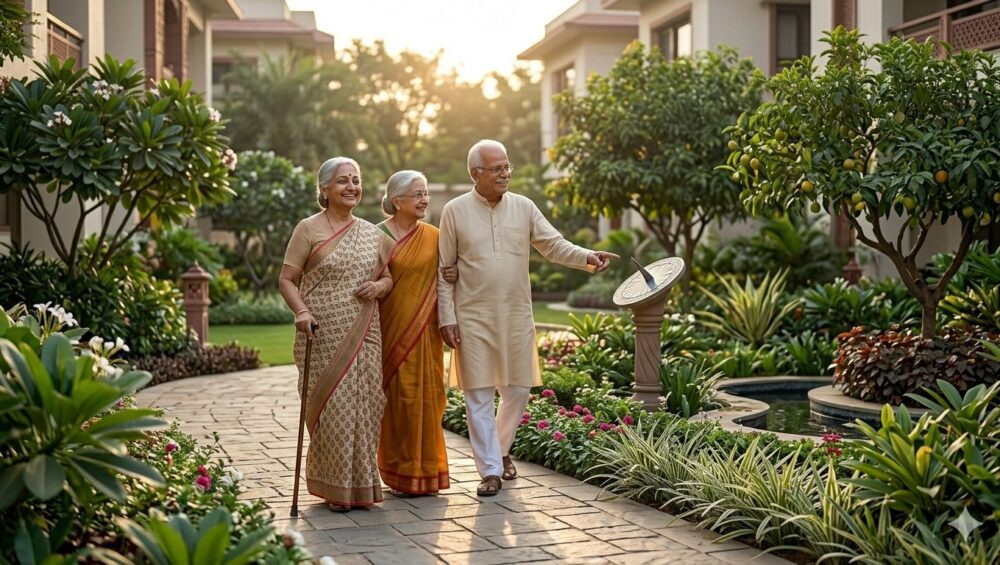
In India, the phrase retirement home still carries a faint unease. It can sound like separation. It can suggest dependence. In some families, it is mentioned cautiously, as though the very idea signals a failure of care. That reaction is understandable, but it belongs to an older way of thinking.
The modern retirement home is not best understood as a place people move to when family disappears. It is better understood as a place designed for a stage of life that asks for different things from a home. Less maintenance. More ease. Fewer domestic complications. Better access to support. More privacy than dependence. More structure than uncertainty.
That is the angle from which retirement homes make sense in contemporary India. They are not an emotional last resort. They are, in many cases, a more suitable arrangement for later life.
So when people ask what are retirement homes, the useful answer is not merely that they are homes for older adults. It is that they are living environments designed around the practical and social realities of ageing. They replace friction with support, isolation with community, and household burden with a more settled daily rhythm.
Why retirement homes are often misunderstood in India
Much of the misunderstanding comes from the way Indian families have traditionally imagined ageing. Parents lived with children. The household absorbed the older generation into its structure. Care was not a separate system; it was folded into family life.
That arrangement still exists, and for many families it works well. But the conditions around it have changed. Children move cities. Work becomes more consuming. Homes become vertically designed and staff-dependent. Parents live longer, often in good health, but not always with the same appetite for domestic management. A large house that once represented success may begin, quietly, to demand too much: too many stairs, too much supervision, too much reliance on drivers, cooks, repairs, medicines, appointments, and the endless coordination that keeps a household looking effortless from the outside.
This is where the old emotional language around retirement homes becomes inadequate. It assumes only two options: stay in the family home or be sent away from it. But many older adults are not choosing between love and loneliness. They are choosing between one kind of living arrangement and another. The question is no longer only who cares. It is also how life is organised.
A retirement home becomes relevant at precisely that point.
What are retirement homes, really?
Retirement homes are residential communities designed for older adults who want a safer, more manageable, and better-supported way to live. They are built around the needs of age, not retrofitted awkwardly around them.
That distinction matters. In a conventional home, the older person is often required to adapt constantly to the environment. In a retirement home, the environment is designed to adapt to the person.
This usually means simpler movement through spaces, safer bathrooms, more responsive support systems, easier access to meals and housekeeping, better security, and some degree of healthcare coordination. It also means living among peers, in a setting where daily life does not have to be held together by personal supervision alone.
Some retirement homes are intended for active seniors who are entirely independent but want a more effortless life. Others are designed for residents who need help with medication, dressing, mobility, bathing, or routine care. The term covers several formats, but the underlying principle remains the same: the home is designed to reduce the strain that ordinary domestic life can place on older adults.
So if one were to answer the question what are retirement homes in one sentence, it would be this: they are purpose-built homes for later life.
The different types of retirement homes for senior citizens
One reason families become confused is that they treat all retirement homes as one category. They are not.
The first type is independent senior living. This suits older adults who can manage their own day but no longer want the operational burden of running a full household. They may want their own apartment or villa, but within a community where meals, maintenance, housekeeping, transport, security, and social spaces are already in place. These residences often feel closest to private residential living, only better calibrated for age.
The second type is assisted living. This is for seniors who are still capable of living with dignity and autonomy, but need regular support with daily routines. The assistance may involve bathing, dressing, medication management, mobility, or meal support. The resident still has privacy, but help is woven more visibly into the day.
The third type includes higher-care settings, where medical supervision, memory care, or more structured nursing support becomes necessary. These environments are more clinical in organisation, though the better ones still try to preserve warmth and personal dignity.
This is important because when families search for retirement homes for senior citizens, they are often searching with one mental image and encountering three different models. Clarity begins when the category is separated into these distinct forms.
What life in a retirement home actually looks like
The easiest way to understand retirement homes is to stop defining them and start picturing the day.
A resident wakes in a space that is easier on the body than the old family home. The bathroom is safer. Breakfast does not depend on whether the cook has arrived or whether someone remembered to buy provisions. The corridors are clean. The grounds are maintained. There may be a morning walk, a newspaper in the lounge, a yoga session, physiotherapy, prayer, bridge after lunch, tea with neighbours, a doctor’s consultation, a quiet afternoon with a book, dinner served without negotiation.
Nothing about this is dramatic. That is the point.
The appeal of retirement living lies in how much invisible labour it removes. No chasing service people. No worrying about security in an under-occupied house. No handling domestic staff turnover. No coordinating every errand personally. No pretending that a fall, a missed medicine, or an unexpected dizzy spell will somehow solve itself.
A good retirement home gives the day a steadier shape. It does not make life smaller. It makes it lighter.
Why more families are considering retirement homes for senior citizens
The interest in retirement homes is rising because they answer a need that many families now recognise but do not always name clearly.
Older adults want independence, but not isolation. Children want parents to be well cared for, but may not be able to reorganise their entire lives around that responsibility. Parents may not want to move into a son’s or daughter’s household and live by another family’s pace, routines, and compromises. Nor do they want to remain alone in homes that are too large, too inconvenient, or too dependent on constant supervision.
A retirement home offers another possibility. It allows an older adult to keep an independent address, a social environment, and a coherent daily routine, while reducing the fragility of living alone.
There is also a quieter reason this category is growing, especially among more established families. People who have spent a lifetime living to a certain standard do not want old age to feel improvised. They do not want support to arrive in a chaotic or makeshift form. They want order, discretion, polish, and a setting that still feels compatible with the way they have lived all along. The better retirement communities understand this. They are not merely functional. They are composed.
That composure matters more than brochures know how to say.
The main benefits of retirement homes
The first benefit is ease. Ordinary life becomes less administrative. Meals, maintenance, housekeeping, security, and often transport are handled within a system rather than through daily personal management.
The second is safety. Retirement homes are usually designed with older bodies in mind. Lighting, flooring, bathrooms, emergency response, and staff availability all contribute to a greater sense of confidence. Safety is not only about crisis. It is also about moving through the day without low-grade anxiety.
The third is access to support. In many retirement homes, healthcare help is easier to arrange and more closely linked to the living environment. Medication management, physiotherapy, doctor visits, and emergency coordination become far less cumbersome.
The fourth is social texture. Many older adults living alone do not lack affection; they lack the presence of everyday company. A retirement home restores that texture without forcing sociability. One can have conversation when desired and privacy when preferred.
The fifth is dignity. This may be the most important of all. Many parents do not want every practical need routed through their children. They would rather pay for support than repeatedly request it. A retirement home allows family relationships to remain family relationships, instead of slowly turning into management structures.
Who are retirement homes right for?
Retirement homes are right for older adults who want independence without the burden of running a large or complicated household. They suit those who value order, privacy, and a more settled routine. They make particular sense for people whose children live elsewhere, for couples who want to simplify life while they are still well enough to enjoy it, and for those who have begun to feel that the old house asks more from them than it gives back.
They are also right for a certain type of judgment. Not every move to a retirement home is driven by immediate need. Some are driven by foresight. By the recognition that life can be arranged better before difficulty becomes urgent.
This is an important shift in how the subject should be understood. Retirement homes for senior citizens are not only for those who are frail or unwell. In many cases, they are chosen by people who are still active, socially aware, financially secure, and perfectly capable of deciding how they would prefer to live.
How to choose a good retirement home
A well-designed website is not enough. Families have to pay attention to the lived character of the place.
The right retirement home should feel calm, not empty. Well-run, not rigid. The staff should be attentive without becoming intrusive. The dining area should feel civil. The common spaces should actually be used. Residents should appear settled rather than parked. Medical support should feel real, not vaguely promised.
It is also worth noticing whether the property carries itself with a certain quiet assurance. The better places do not feel theatrical. They feel composed. The landscaping is tidy without excess. The interiors are pleasant without looking contrived. The atmosphere is neither clinical nor careless. It resembles a private residential world that has been intelligently adapted to the needs of age.
That is often the difference between a retirement home that merely houses older adults and one that supports them well.
A more mature way to think about senior living in India
India is slowly developing a more adult vocabulary around ageing. That is a welcome change.
For too long, every conversation about senior living was forced into a moral frame: if a parent lived in a retirement home, did that mean the family had failed? The better question is whether the person is living in an environment that serves them properly.
A good retirement home does not replace affection. It replaces avoidable strain. It allows older adults to live with greater ease, better support, and often more companionship than they would have had in an isolated household arrangement. It also allows children to remain emotionally present without having to become full-time coordinators of domestic and medical life.
Seen clearly, this is not abandonment. It is arrangement.
And in later life, arrangement can be a form of care.
Conclusion
So, what are retirement homes?
They are not simply places where older people go when they cannot remain elsewhere. They are living environments designed for a stage of life in which ease, safety, routine, support, and dignity begin to matter more than the scale of the house or the symbolism of staying in it.
The growing relevance of retirement homes for senior citizens in India reflects a broader social truth: ageing has changed, families have changed, and the idea of care has changed with them. A retirement home, at its best, is not a retreat from life. It is a better setting for it.
For some older adults, that setting may be the difference between managing life and actually living it.
FAQs
Q1. What are retirement homes?
Ans. Retirement homes are residential communities designed for older adults. They offer a safer, more manageable living environment, often with services such as meals, housekeeping, security, healthcare support, and social spaces.
Q2. Are retirement homes and old age homes the same?
Ans. Not always. Old age homes are often understood as a broader or more basic category. Modern retirement homes usually refer to more organised senior living communities with better infrastructure, stronger service standards, more privacy, and a more comfortable lifestyle.
Q3. Who should consider retirement homes for senior citizens?
Ans. They are suitable for seniors who want convenience, safety, support, and social connection, especially if living alone or managing a large home has become tiring or impractical.
Q4. Do retirement homes reduce independence?
Ans. A well-run retirement home usually preserves independence by removing domestic burdens and making support available when needed, without taking away privacy or personal choice.
Q5. What services do retirement homes usually provide?
Ans. Most provide accommodation, meals, housekeeping, maintenance, security, and access to common areas. Some also offer assisted living, medication management, nursing support, physiotherapy, and medical coordination.